Tag: MT103 SWIFT

  • PACS.008 vs MT103: Why the New ISO 20022 Message Changes Cross Border Payments

    PACS.008 vs MT103: Why the New ISO 20022 Message Changes Cross Border Payments

    If you’ve ever tracked an international wire or asked a bank for proof of payment, you’ve probably run into an MT103. That message has been the workhorse of customer credit transfers on the SWIFT network for decades. Its replacement, pacs.008 (full name: FIToFICustomerCreditTransfer), is now the standard under ISO 20022. The switch isn’t just a format update, it brings structured data, better tracking, and fewer manual fixes.

    NEED THE PACS.008/MT103 SOFTWARE? contact us right away!

    Lets talk about MT103 and What MT103 does.

    What MT103 Actually Does

    MT103 is a SWIFT FIN message type used for single customer credit transfers. Banks send it to move money from one customer’s account to another, often across borders. It carries the essentials in tagged fields:

    • Field 20: sender’s reference
    • Field 32A: value date, currency, and amount
    • Field 50: ordering customer
    • Field 59: beneficiary
    • Field 70: remittance information (limited to a few lines of free text)
    • Field 71A: who pays the charges (OUR/BEN/SHA)

    The format is text-based and relatively compact. It works, but free-text addresses and limited remittance details often force banks to re-key data or hold payments for compliance checks. Character limits and unstructured fields create friction, especially with sanctions screening or regulatory reporting.

    A Closer Look at PACS.008

    pacs.008 belongs to the ISO 20022 “pacs” (payments clearing and settlement) family. It is the interbank instruction that tells one financial institution to credit a customer’s account on behalf of another. Your bank generates it after you initiate a transfer whether through online banking, a corporate ERP system, or a pain.001 initiation message.

    The message is XML-based and splits into two main blocks:

    • Group Header – common data for the whole message (message ID, creation timestamp, number of transactions, settlement method).
    • Credit Transfer Transaction Information – the actual payment details (debtor, creditor, amounts, agents, remittance info).

    Key elements include:

    • Structured party identification (name, postal address broken into street, town, country, postcode; optional LEI for legal entities).
    • Multiple agent roles with dedicated fields (debtor agent, creditor agent, up to three intermediary agents, previous agents, reimbursement agents).
    • Clear separation of instructed amount and interbank settlement amount.
    • Charge bearer codes (DEBT / CRED / SHAR / SLEV) that map cleanly to the old OUR/BEN/SHA.
    • Richer remittance information that can be structured (with purpose codes, invoice references) or unstructured.
    • Native UETR (Unique End-to-End Transaction Reference) for end-to-end tracking via SWIFT gpi.

    Because it is part of a global standard rather than a SWIFT-proprietary format, pacs.008 appears in domestic systems (SEPA, TARGET, CHAPS, Fedwire, etc.) as well as cross-border flows under SWIFT’s CBPR+ rules. It can carry one transaction or, in some schemes, batches though many high-value rails still limit it to a single payment.

    Side-by-Side Comparison

    ASPECTMT103PACS.008
    FormatTagged text (FIN)Structured XML (ISO 20022)
    Address dataUnstructured free textStructured (street, town, country, etc.)
    Remittance informationLimited free text (field 70)Structured or unstructured, far more capacity
    Party identificationName + limited addressName, structured address, LEI, multiple IDs
    AgentsLimited dedicated fieldsExplicit fields for multiple intermediaries
    TrackingUETR added later (field 121)UETR native and mandatory
    Character setRestricted SWIFT setFull UTF-8
    Message sizeRelatively smallMuch larger, richer data
    Status reportingFree-text or separate MTsLinked pacs.002 with precise codes

    The practical result: fewer compliance holds, less re-keying at correspondent banks, clearer purpose codes, and better automation for AML, sanctions, and reconciliation.

    Software Precision and Implementation Reality

    Because pacs.008 is XML with strict schemas (XSD) and market-practice rules (CBPR+, HVPS+, SCT Inst, etc.), software can validate it rigorously. Good tooling checks:

    • Schema compliance and version (common versions include 001.08 and later).
    • Mandatory structured address elements (especially important as unstructured addresses face deadlines).
    • Valid IBAN, BIC, and LEI formats and checksums.
    • Settlement dates against local calendars.
    • Correct charge-bearer codes and agent sequencing.
    • Character-set compliance and data truncation risks.

    Libraries and platforms (Python packages such as those built around xsdata or dedicated pacs.008 generators, commercial validation engines, bank middleware) can generate, parse, and audit messages against both the core ISO schema and scheme-specific profiles. Validation can run in dry-run mode before a message is sent, catching errors that would previously surface only after a payment was rejected or delayed.

    Precision is high when the software follows the published rulesets. However, quality still depends on the data fed into it. Incomplete address details or missing purpose codes will fail modern checks even if the XML is technically well-formed. Banks and corporates that invest in clean master data and mapping layers see the biggest gains in straight-through processing rates.

    Why the Change Matters

    SWIFT’s migration timeline has made pacs.008 the primary format for cross-border customer credit transfers. The richer data reduces repair rates, speeds up compliance decisions, and gives everyone in the chain better visibility. For businesses that receive international payments, structured purpose codes and complete addresses mean fewer “refer to drawer” delays and cleaner reconciliation. For banks, it supports automated screening and clearer audit trails.

    If you still hear requests for an “MT103,” most of the time the requester simply wants confirmation of payment. The equivalent proof is now the pacs.008 itself (or the related status reports and UETR tracking information).

    NEED THE PACS.008/MT103 SOFTWARE? contact us right away!

    The move from free-text tags to structured XML is not cosmetic. It changes how reliably money and information travel together. Banks and software teams that treat pacs.008 as more than a mechanical replacement of MT103 are the ones extracting the real operational benefit.
  • MT103 SWIFT Payment Software Flash Funds

    MT103 SWIFT Payment Software Flash Funds

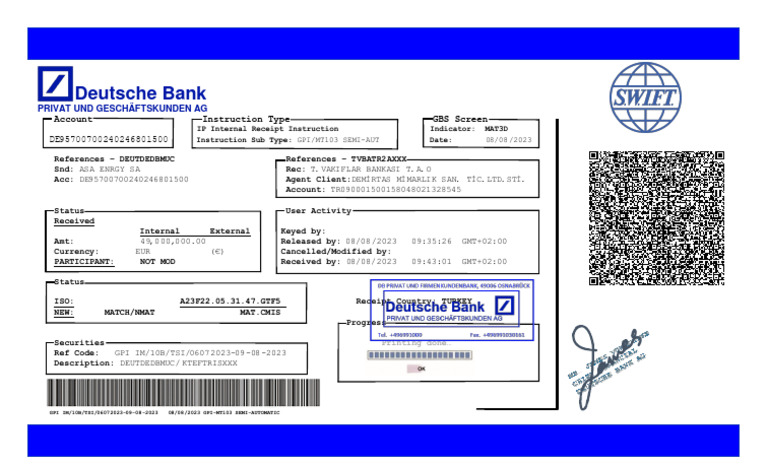
    Get MT103 SWIFT Payment Software Flash Funds if you want to do MT103 swift payment with GPI automatic, MT202, MT700, MT760, MT799, MT199 and more. Cash/credit transfer, IPIP, IPID, DLC and custom CIS then you must need the MT103 Swift software;

    YouTube player

    Click Here To Get MT103 Swift Payment Software With Flash Funds Enabled.

    With MT103 Swift Payment Software you can do the following types of payments:

    • Local Payment (NIP/INTER-BANK/NATIONAL): local payment is when you want to pay someone in Russia and you are also living in Russia then you want to pay the person (local bank transfer), in this case the payment will arrive instantly.
    • Cross Boarder Payment: cross boarder payment is when you live for example, in India or any other country in the world and you want to pay someone in Australia (it can be tagged “swift payment”), in this case the MT103 cash or credit transfer will not arrive or reflect instantly on receiver’s bank account available balance. It will take two to three (2-3) business days to arrive into beneficiary’s bank account available balance.

    Most of these scammers set this payments, configure it before they begin the transaction initiation using MT103 Swift Software.

    What is MT103 Swift Payment System Used For?

    Mainly, it’s used for mt103 swift, the key features of it are listed on first paragraph, cyber criminals misuse it as well for flash payments if the flash funds option is enabled.

    Cyber criminals use this software for flash funds payments to finalise business deals, purchase of goods (digital assets inclusive such as bitcoin or usdt tokens on P2P platforms) learn more here.

    Most of these criminals operate in person as well with people whom don’t know them or their real identity and disappear, majority of these criminals use thi mt103 software for P2P payments on crypto exchanges, they open an order for usdt or bitcoin and pay with it.

    MT103 Swift Payment

    With the flash funds option enabled on the mt103 software they are able to make payments of millions for digital assets, this has been a weapon for these cyber criminals against businesses and individuals which has plunged many individuals into bankruptcy as a result of this.

    How Cybercriminals Commit Bank Fraud Using MT103 Swift Payment System

    They can easily send $1,000 and above to any bank account in the world and the beneficiary (their victim) will receive it instantly as local payment or within three (3) business days as swift/foreign wire transfer (cross boarder) payment.

    Does The Flash Funds Reflect On Bank Account Available Balance?

    This specific flash funds payment or MT103 swift payment with flash enabled that cybercriminals use to make money off P2P traders or business/companies actually reflects on bank account available balance, the answer to this question is (YES).

    Breakdown Of Flash Funds Reflection On Bank Account Available Balance

    For example, you are the victim that is targeted and you already have one hundred thousand dollars ($100,000) in your bank account as current available balance then the cyber criminal sends you twenty thousand dollars ($20,000) to your bank account, upon the arrival of the inward payment (inflow), to your bank account, the current available balance of your bank account will be updated to one hundred and twenty thousand dollars ($120,000).

    MT103 SWIFT Payment Software Flash Funds

    This is how the flash funds into bank account available balance works, it is how the reflection of the flash funds occurs when cyber criminals initiate the flash funds transaction.

    How Cybercriminals Buy Crypto With MT103 Flash Funds Payment

    The criminal (buyer) will appear as buyer of your digital asset while some will use it for various things and after they pay their victim (seller) of digital assets, when the victim (seller) confirms payment has been received amd releases the digital asset to the buyer (the cyber criminal) that’s it.

    Whatever the issue with payment involving bank that comes up afterwards is all on the victim to deal with, this has led thousands of P2P traders around the world to huge loss.

    How P2P Crypto Traders Lose Millions To Flash Funds Scam

    A cyber criminal will download a crypto exchange app, most of them use Binance, Inflowbit, Kucoin, Kraken or Bitget and more. After they downloaded this app they will buy verified crypto exchange account and they will login with the info and open trade to buy crypto in the P2P section, any victim that comes forward to sell to them, they will flash their account with the exact amount generated on the P2P platform for the order, the victim will confirm payment and release the digital asset to the scammer.

    The MT103 Flash Payment will fail after the designated time of hibernation, this will trigger bank’s security system to flag the customer’s account as fraud, the bank will then go ahead to make decision which will lead to the victim losing their digital asset sold and their account closed for fraud;

    Have it on mind there are two types of Flash Funds and the following are the breakdown.

    Two (2) Types Of Flash Funds

    There are two types of flash funds and they vary just like there are different types of swift messaging ranging from 103 to 202 types and more, it depends on what is being targeted or scammer’s needs,

    How Many Types Of Flash Funds Exist?

    Only two types of flash funds exist, Fake Bank Alert that is commonly done by text and phone number and Flash Payment that us done with MT103 Swift Payment System Flash Enabled.

    What’s The Difference Between Flash Funds And Fake Bank Alert?

    The difference between Fake Bank Alert and Flash Funds is clear, it is not something anyone can be confused of.

    Break Down Of Flash Funds And Fake Bank Alert Difference

    Fake Bank Alert: this means, it will be just mere fake credit alert and it won’t reflect on bank account available balance, it will not be anywhere near authentic enough to be convincing because for any scammer who wants to do fake bank alert to someone they are targeting as their victim, they will need to obtain the following informations;

    • Bank account details
    • Phone number (the correct one linked to the receiver’s bank account which the receiver use to receive bank alerts)
    • Email address (the correct email linked to receiver’s bank account)

    What Does The Scammer Need Above Information For?

    The scammer will need the above informations to use them and send the target the fake bank credit alert using fake bank alert platform, now take note;

    Even if the scammer is able to obtain the above details, what about the current figure that is in the target’s bank account as available balance? That’s where they will easily be caught and mission will fail instantly.

    In a clear explanation, you have one million pounds sterling (ÂŁ1,000,000) in your bank account available balance and a scammer that wants to defraud you with fake bank alert sends you fake alert and you are seeing one hundred thousand as your bank available balance would you foolishly fall for such cheap scam? Ofcourse you will not,

    It will raise suspicion that will lead to thorough further check because the numbers don’t add up, learn more on how to detect fake bank alert here and stay informed.

    MT103 Swift Payment System Flash Enabled

    This means, it is not mere fake bank alert because for any scammer to do flash funds transaction they will need just the receiver’s basic bank details that is required for normal bank transfers (to receive payment).

    Kindly take note, they don’t need any of the following details!

    • Receiver’s phone number
    • Receiver’s email address
    • Knowledge of receiver’s current balance

    MT103 Swift Payment System With Flash Enabled will handle the rest, just receiver’s bank account details for receiving of payment is required, the cyber criminal will send exact amount agreed on wether is physical goods purchase or digital asset such as cryptocurrency, the payment will reflect on receiver’s bank account available balance and it will be updated to new balance,

    There will be no suspicion until business or transaction with the party is closed and they moved on, the victim will face bank problems for fraudulent activity accusation.

    The payment will be flagged and deemed suspicious and inauthentic transaction, some banks may tag it “Failed” then go on to add the customer on watch list,

    If you are an active P2P trader reading this article you must have experienced this before, in some cases receiving fraudulent money, you must have encountered this problem whereby your bank blocked your account for fraudulent activity or the payment you confirmed is nowhere to be found after you have released digital asset to the buyer and even if you report them to the exchange they can’t be traced because they withdraw the assets immediately after you released them and they will abandon that account, buy another one and start again.

    How MT103 Swift Flash Works

    Mt103 flash works by establishing hybernated prepayment in an encryption flow between receiver’s banking system and the MT swift (MFFS often use the JOIPsc or SVVER/PYTT protocols). All outflows from the system locks in a command for payment authenticity checking initiation to commence after a designated time frame.

    Does MT103 Swift Flash Require VPN?

    No VPN is required from the user of the software, all activities on the software are encrypted. The system automatically provides different IP every minute and points to different locations in the world that even if cracked you can’t be traced, this is to conceal in event of any attack to protect users.

    MT103 SWIFT Payment Software Flash Funds

    How To Get MT103 Swift Payment System

    Click Here To Get MT103 Swift Payment Software With Flash Funds Enabled.

    Any Additional Costs After Purchasing The MT103 Swift Payment Software?

    No, there is no additional cost when you get the mt103 swift payment software flash funds, it’s one payment and full access is granted that will last for 12 months, for further inquiry on MT103 SWIFT payment software flash funds kindly hit the contact button below and talk to our support.

  • MT103 SWIFT message types

    MT103 SWIFT message types

    MT103 SWIFT message types are the format or schema used to send messages to financial institutions on the SWIFT network. The original message types were developed by SWIFT and a subset was retrospectively made into an ISO standard, ISO 15022. In many instances, SWIFT message types between custodians follow the ISO standard.[1] This was later supplemented by a XML based version under ISO 20022.

    Composition of MT number

    SWIFT messages consist of five blocks of data including three headers, message content, and a trailer. Message types are crucial to identifying content, all SWIFT messages include the literal “MT” (message type/text). This is followed by a three-digit number that denotes the message category, group and type. Consider the following two examples.

    First Example Of MT103 SWIFT Message Types

    MT103

    1. The first digit (3) represents the category. A category denotes messages that relate to particular financial instruments or services such as precious metals (6), treasury (3), or traveller’s cheques (8). The category denoted by 3 is treasury markets
    2. The second digit (0) represents a group of related parts in a transaction life cycle. The group indicated by 0 is a financial institution transfer.
    3. The third digit (4) is the type that denotes the specific message. There are several hundred message types across the categories. The type represented by 4 is a notification.

    A MT304 message is considered an “Advice/Instruction of a Third Party Deal” and it used to advise of or instruct the settlement of a third party foreign exchange deal.

    For example, an asset manager who executed a FX transaction with a broker would send a MT304 instruction to the custodian bank of the client.

    Second Example Of MT103 SWIFT Message Types

    MT103

    1. The first digit (1) represents the category. The category denoted by 1 is customer payments and cheques.
    2. The second digit (0) represents a group of related parts in a transaction life cycle. The group indicated by 0 is a financial institution transfer.
    3. The third digit (3) is the type that denotes the specific message. There are several hundred message types across the categories. The type represented by 3 is a notification.

    A MT103 message is considered a “Single Customer Credit Transfer” and is used to instruct a funds transfer.

    Below shows the different categories and the message type descriptions, the categories, message types and description Number of message types:

    • 0 MT0 – System messages
    • 1 MT1 – Customer payments and cheques 19
    • 2 MT2 – Financial institution transfers 18
    • 3 MT3 – Treasury markets 27
    • 4 MT4 – Collection and cash letters 17
    • 5 MT5 – Securities Markets 60
    • 6 MT6 – Treasury markets – metals and syndications 22
    • 7 MT7 – Documentary credits and guarantees 29
    • 8 MT8 – Traveller’s cheques 11
    • 9 MT9 – Cash management and customer status 21

    ISO 15022 MT

    Although ISO 15022 message types are different in their structure from the SWIFT MT, the naming convention remains the same, message types defined in ISO15022 “ISO15022 Data Field Dictionary – Index of Messages” ISO.

    Where To Get MT103 Swift Payment Software

    If you want to get the mt103 swift payment software kindly click here, use this software to pay for crypto P2P orders on any crypto exchanges, learn more here on how cybercriminals are using MT103 swift payment software to make millions. For further inquiry kindly contact support through the support button on site below.

error: Content is protected !!