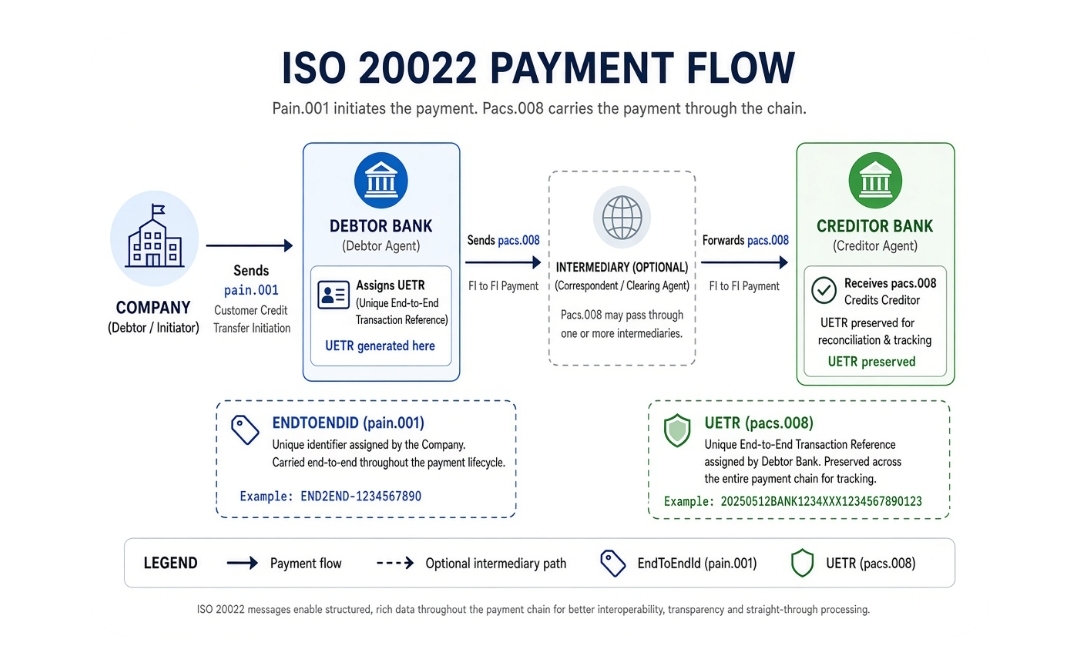
Pacs.008 (FIToFICustomerCreditTransfer) is the ISO 20022 message banks use to move customer funds between financial institutions. It replaced the legacy SWIFT MT103 for customer credit transfers and is now standard across SEPA, SWIFT CBPR+, TARGET/T2, Fedwire, CHAPS, and other systems.

This guide explains what a pacs.008 transfer is, how the message is structured, the difference between serial and cover methods, and the practical steps to set one up correctly.
What Is a Pacs.008 Transfer?
A pacs.008 is an interbank message that instructs the movement of funds from a debtor (payer) account to a creditor (beneficiary) account. It lives strictly in the bank-to-bank space.
The typical flow:
- Customer (or corporate system) sends a pain.001 (Customer Credit Transfer Initiation) to their bank.
- The bank validates it and returns a pain.002 status.
- The debtor’s bank creates and sends a pacs.008 into the clearing or correspondent network.
- Status updates travel as pacs.002.
- The creditor’s bank credits the beneficiary and may notify them via camt messages.
A company or individual cannot send a pacs.008 directly. It is always generated by a financial institution (or its payment processor).
Pacs.008 vs MT103
| Aspect | MT103 | Pacs.008 |
| Format | Fixed text fields | Structured XML |
| Data richness | Limited, often free text | Structured names, addresses, remittance, purpose |
| Tracking | UETR (optional) | EndToEndId + TxId + UETR (UUID) |
| Charges | OUR / BEN / SHA | DEBT / CRED / SHAR / SLEV |
| Status reporting | MT199 / MT196 etc. | Structured pacs.002 |
The richer data in pacs.008 improves sanctions screening, automated reconciliation, and straight-through processing (STP).
Core Structure of a Pacs.008 Message
A pacs.008 has two main blocks:
1. Group Header (GrpHdr), shared across all transactions in the message
- MsgId — unique point-to-point reference (max 35 characters)
- CreDtTm — creation timestamp (ISO 8601)
- NbOfTxs — number of transactions
- SttlmInf / SttlmMtd — settlement method (CLRG, INDA, INGA, or COVE)
2. Credit Transfer Transaction Information (CdtTrfTxInf) — one block per payment
- PmtId — InstrId, EndToEndId, TxId, UETR
- IntrBkSttlmAmt + IntrBkSttlmDt
- InstdAmt (original amount, useful with FX)
- ChrgBr (charge bearer)
- Debtor / Debtor Account / Debtor Agent
- Creditor / Creditor Account / Creditor Agent
- Intermediary agents (if any)
- Remittance information (RmtInf — structured or unstructured)
- Purpose code, regulatory reporting, etc.
Most production systems also wrap the message in a Business Application Header (BAH / head.001).
Step-by-Step: How to Set Up a Pacs.008 Transfer
Step 1: Choose the Correct Scheme and Version
Different environments use different versions and rules:
- SEPA SCT / SCT Inst → typically pacs.008.001.08 with EPC implementation guidelines
- SWIFT CBPR+ (cross-border) → pacs.008.001.08 (or later) with MyStandards usage guidelines
- Domestic systems (Fedwire, CHAPS, Lynx, T2, etc.) have their own usage guidelines on top of the ISO schema
Always use the scheme-specific XSD and usage guidelines, not just the generic ISO schema.
Step 2: Obtain Schemas and Guidelines
Download:
- Official ISO 20022 message definition and XSD from the ISO 20022 catalogue
- Scheme-specific rules (EPC for SEPA, SWIFT CBPR+ User Handbook and MyStandards for cross-border)
- Any local market practice documents
Step 3: Map Your Payment Data
Common sources:
- Internal payment engine
- Incoming pain.001
- Legacy MT103 (during migration)
Critical mappings include EndToEndId (must remain unchanged end-to-end), UETR (generate UUID v4 once and keep it), structured postal addresses, and charge bearer.
Step 4: Decide Settlement Method and Routing
| Method | Meaning | Typical Use |
| CLRG | Settles through a clearing system | SEPA, RTGS, domestic clearing |
| INDA | Instructed agent settles | Correspondent banking (nostro at receiver) |
| COVE | Cover method | Cross-border with separate funding leg (pacs.009 COV) |
Serial method: The pacs.008 travels hop-by-hop. Each bank forwards a new (or updated) pacs.008.
Cover method: One pacs.008 goes directly to the creditor agent (with customer data), while a separate pacs.009 COV moves the funds through correspondents.
Step 5: Generate and Validate the XML
- Build a valid XML instance against the correct XSD.
- Apply scheme-specific business rules (character set, mandatory fields, address structure, BIC/IBAN checks, etc.).
- Tools such as open-source validators or commercial payment engines help catch errors before transmission.
Step 6: Send the Message
Transmission channels include:
- SWIFT FINPlus (CBPR+)
- SEPA Clearer / EBA Clearing / TIPS
- Domestic RTGS or instant payment systems
- API gateways provided by correspondent banks
Step 7: Process Status and Exceptions
- Expect pacs.002 status reports (ACCP, ACSP, ACSC, RJCT, PDNG).
- Handle returns with pacs.004.
- Use pacs.028 when status is unknown.
- Monitor UETR for end-to-end tracking (especially with SWIFT gpi).
Simplified Pacs.008 Example
xml
<Document xmlns="urn:iso:std:iso:20022:tech:xsd:pacs.008.001.08">
  <FIToFICstmrCdtTrf>
    <GrpHdr>
      <MsgId>MSG-2026-001</MsgId>
      <CreDtTm>2026-10-12T10:00:00Z</CreDtTm>
      <NbOfTxs>1</NbOfTxs>
      <SttlmInf>
        <SttlmMtd>INDA</SttlmMtd>
      </SttlmInf>
    </GrpHdr>
    <CdtTrfTxInf>
      <PmtId>
        <EndToEndId>INV-2026-00142</EndToEndId>
        <UETR>eb6305c4-3e7a-4b29-9a1f-8d2ce5a71b30</UETR>
      </PmtId>
      <IntrBkSttlmAmt Ccy="USD">75000.00</IntrBkSttlmAmt>
      <IntrBkSttlmDt>2026-10-13</IntrBkSttlmDt>
      <ChrgBr>SHAR</ChrgBr>
      <Dbtr>
        <Nm>Acme Trading GmbH</Nm>
        <PstlAdr>
          <StrtNm>Hauptstrasse 42</StrtNm>
          <TwnNm>Frankfurt</TwnNm>
          <Ctry>DE</Ctry>
        </PstlAdr>
      </Dbtr>
      <DbtrAcct>
        <Id><IBAN>DE89370400440532013000</IBAN></Id>
      </DbtrAcct>
      <DbtrAgt>
        <FinInstnId><BICFI>COBADEFFXXX</BICFI></FinInstnId>
      </DbtrAgt>
      <CdtrAgt>
        <FinInstnId><BICFI>CHASUS33XXX</BICFI></FinInstnId>
      </CdtrAgt>
      <Cdtr>
        <Nm>Global Supplies Inc.</Nm>
      </Cdtr>
      <CdtrAcct>
        <Id><Othr><Id>483926175012</Id></Othr></Id>
      </CdtrAcct>
    </CdtTrfTxInf>
  </FIToFICstmrCdtTrf>
</Document>
This is a simplified teaching example. Production messages must follow the exact scheme rules and include all mandatory elements.
Best Practices and Common Pitfalls
- Prefer structured addresses (Town Name + Country at minimum).
- Unstructured addresses are being phased out in many systems (CBPR+ deadline around late 2026).
- Keep EndToEndId and UETR unchanged throughout the payment chain.
- Use structured remittance (RmtInf/Strd) whenever possible for better reconciliation.
- Validate IBAN, BIC, and character set before sending.
- Test thoroughly against the target scheme’s rules, generic ISO validation is not enough.
- Plan for both serial and cover flows if you handle cross-border payments.
Frequently Asked Questions
Summary (Conclusion)
Setting up a pacs.008 transfer correctly requires understanding the scheme rules, mapping data accurately, choosing the right settlement method, and validating thoroughly before transmission, if you need help setting it up contact us right away. The structured nature of the ISO 20022 message delivers better automation, compliance, and visibility compared with the old MT103 format.
Start by downloading the official usage guidelines for your target scheme (SEPA, SWIFT CBPR+, or your domestic system), then implement generation and validation in a controlled test environment before going live.